
How to Sleep After Shoulder Surgery: A Surgeon's Guide to Getting Through the Night

By Dr. C. Lucas Myerson, MD — Shoulder & Elbow Surgery, Northwell Health / Lenox Hill Hospital
Sleep is one of the most common complaints I hear from patients in the first weeks after shoulder surgery. You're exhausted, uncomfortable, and every time you drift off, the wrong movement wakes you up. It's frustrating, and it's nearly universal.
The good news is that most patients do find their rhythm after a few weeks. The better news is that there are concrete strategies that can help you get there faster.
Why Sleep Is So Hard After Shoulder Surgery
Before we get to solutions, it helps to understand what's working against you.

Pain and inflammation peak in the first 48–72 hours and remain significant for one to two weeks. At night, with fewer distractions and a drop in your body's natural cortisol, pain often feels more intense.
The sling keeps your arm in a fixed position, which is necessary for healing, but deeply unnatural for sleep. Most people are side sleepers, and the sling effectively takes that option off the table for the operative arm.
Position-dependent swelling can worsen when you lie flat. Gravity no longer helps drain the shoulder, which can increase pressure, throbbing, and stiffness at night.
Disruption of the sleep cycle is a real downstream consequence. Frequent awakenings reduce time in restorative slow-wave and REM sleep, which in turn impairs tissue healing, pain tolerance, and mood.
Position: This Is the Most Important Variable
Getting your position right matters more than anything else on this list.
Option 1: The Recliner (Recommended for Most Patients)
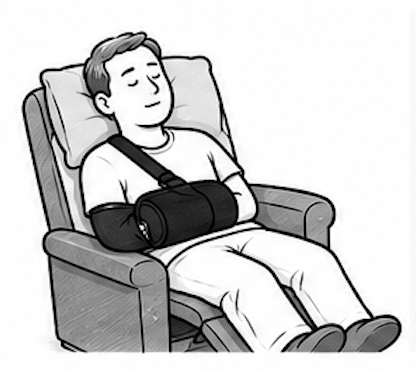
A reclining chair — or a wedge pillow in bed — is the single most effective sleeping position for the first two to four weeks after shoulder surgery. Sleeping at a 30–45 degree incline accomplishes several things at once:
Keeps the shoulder slightly elevated, reducing overnight swelling
Takes gravitational stress off the repaired tissue
Reduces the likelihood of rolling onto the operative side in your sleep

If you don't own a recliner, a large foam wedge (available online for $40–80) placed in bed can replicate the angle. Stack pillows behind it for additional elevation if needed.
Option 2: Sleeping on Your Non-Operative Side

For patients who find the recliner position intolerable, side-sleeping on the non-operative side is an alternative, but it requires setup. Place a pillow in front of your chest to prop the operative arm, preventing it from rolling forward and loading the repair. A second pillow between your knees can improve overall body alignment and reduce restlessness.
What to Avoid

Sleeping flat on your back can increase shoulder pressure and swelling. Sleeping on the operative side is off-limits while you're in a sling and potentially for months afterward depending on your procedure. Your surgeon will specify when this is permitted.
Timing Your Pain Medication
This is one of the most practical interventions.

Rather than waiting until pain wakes you up, consider timing your evening analgesic dose 30–45 minutes before you plan to sleep. This allows the medication to reach therapeutic effect as you're lying down, rather than having you wake at 2 a.m. in pain and then waiting another half hour for relief.
Talk with your surgical team about whether this timing adjustment makes sense given

your specific regimen. If you're on scheduled non-opioid analgesics (e.g. acetaminophen or NSAIDs), optimizing the timing is usually straightforward. If you're managing with opioid medications, your team can help you think through the schedule safely.

Ice before bed. Applying ice (never directly on the skin) to the shoulder for 15–20 minutes before lying down can blunt the inflammatory pain cycle and ease th
e transition to sleep. This simple, effective strategy is as good as any pain medication.
The Sling at Night

Your surgeon will advise you whether to keep the sling on while sleeping. For most rotator cuff repairs and instability procedures, the answer is yes, particularly in the first several weeks. For some arthroplasty patients, nighttime sling use may be relaxed sooner.
When the sling stays on at night, the most common problem is the shoulder rolling forward out of the supported position. A small pillow tucked under the elbow can maintain the correct position and reduce the aching that comes from the arm sagging.
If the sling is causing skin irritation or pressure points at night, a thin cotton undershirt worn beneath it can help.
Sleep Hygiene Adjustments That Actually Matter

The standard sleep hygiene advice applies here, but certain elements are especially relevant in the post-operative period.
Keep the bedroom cool. Inflammatory pain is more sensitive to temperature. A cooler environment (around 65–68°F) can modestly reduce inflammation and improve sleep quality.
Limit screens for 30–60 minutes before bed. Blue light exposure delays melatonin onset. With your baseline sleep already disrupted by pain, you don't want to be fighting your own circadian rhythm.
Consistent wake times. It's tempting to sleep in when you've had a rough night, but irregular sleep schedules fragment sleep architecture further. A consistent wake time helps anchor your circadian rhythm, even if you slept poorly.
Short naps, if needed. If you're significantly sleep-deprived in the early weeks, a 20–30 minute nap in the early afternoon is reasonable. Longer naps or those taken later in the day will interfere with nighttime sleep.
What's Normal, and What's Not
It's worth setting realistic expectations.
Normal: Waking two to four times per night in the first one to two weeks. Difficulty finding a comfortable position. Fatigue that persists through the day. Mild anxiety about protecting the shoulder during sleep.
Worth a call to your surgeon's office: Pain that is acutely worsening after day three to five (rather than slowly improving). Signs of infection at the incision site (increasing redness, warmth, drainage). Fever. Numbness or tingling that is new or worsening.
Sleep will improve. For the vast majority of patients, nights become meaningfully better by weeks three to four, and most are sleeping reasonably well by six to eight weeks.
A Few Things I Tell My Own Patients
Set up your sleeping situation before surgery, not the night you get home. Know where the recliner or wedge is going, have your ice packs ready, and plan your medication timing with your discharge instructions in hand.
Recruit help for the first week. Getting in and out of a recliner with one arm immobilized is harder than it sounds, and disrupted sleep makes you less careful.
Be patient with yourself. Poor sleep is not a sign that something went wrong with your surgery. It's a near-universal feature of early recovery and is one that resolves.
Call to book an appointment:
646-665-6784

Dr. Myerson is an Assistant Professor of Shoulder & Elbow Surgery at Northwell Health / Lenox Hill Hospital, with clinical locations in Manhattan. If you have questions about your recovery after shoulder surgery, contact our office or visit lucasmyersonmd.com.
The information in this post is intended for general educational purposes and does not constitute individualized medical advice. Always follow the specific instructions provided by your surgical team.